


Enigmic: Crime Puzzle Cases
Infinity Games, Lda
I approached Enigmic: Crime Puzzle Cases expecting a straightforward detective game, but its real appeal is more focused: it asks me to turn scattered clues into a defensible conclusion. That single idea gives the experience its identity. Instead of relying mainly on quick reactions or matching patterns, I spend my time reading, comparing details, testing assumptions, and deciding which explanation makes the most sense.
That makes it a particularly good fit for short, thoughtful play sessions. I can open it when I want something more engaging than a casual time-killer but less demanding than a long adventure. The game is free to start, belongs to the puzzle category, and comes from Infinity Games, Lda. Its Everyone rating also makes the presentation approachable for a broad audience, although the crime-solving theme will naturally appeal most to players who enjoy mysteries.
Why deduction is the heart of the experience
The important distinction here is that clues are not just decoration. They are the material I use to build a theory. A successful case depends on noticing relationships between pieces of information rather than treating each clue as an isolated answer. That changes the rhythm completely: I am not simply searching for the next tap, I am trying to understand what the case is telling me.
In practice, this kind of design rewards careful attention more than speed. I find myself slowing down when two details appear to point in different directions. One may establish a timeline, while another changes how I interpret a person’s behavior. The satisfaction comes from resolving that tension without guessing blindly. When the conclusion finally fits, it feels earned because the answer grows out of the evidence.
The strongest part of Enigmic is the conversion of reading into reasoning. Many mobile puzzle games give me a visual obstacle and ask me to manipulate it. Here, the obstacle is uncertainty. I have to decide which details matter, which ones support each other, and which apparent lead is a distraction. That is a more deliberate form of play, and it gives the cases a slower but more personal pace.
Related News






How I approach a case without losing the thread
My most useful habit is to avoid making a final judgment as soon as I see a suspicious clue. I first separate what is directly established from what I am merely assuming. That small distinction prevents a common mistake in deduction games: building an elaborate theory around one interesting detail before checking whether the rest of the case supports it.
I also revisit the information in a fixed order. I begin with the basic circumstances, then look at the people involved, and only afterward compare motives or contradictions. This makes it easier to spot when a theory depends on a detail that does not actually fit the sequence of events. Even when the game keeps the presentation simple, this personal workflow makes the experience feel more like investigation and less like trial and error.
A second useful approach is to treat wrong answers as feedback about my reasoning rather than as a reason to tap randomly. If an interpretation fails, I ask which assumption caused the problem. Did I confuse a possibility with a fact? Did I overlook a contradiction? Did I give too much importance to a dramatic clue? That mindset is especially helpful for players who usually become frustrated when a puzzle answer is not immediately obvious.
Gallery
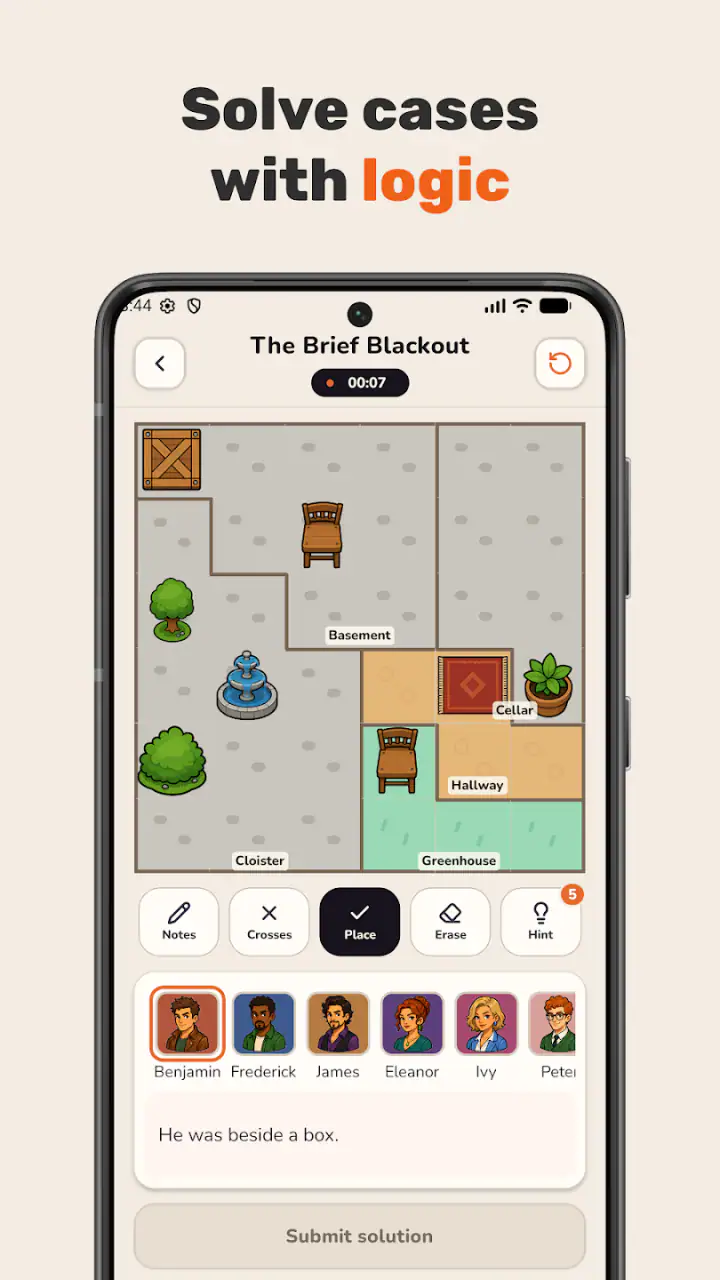
The game is also better suited to focused attention than to background play. I would not recommend opening it while watching a show or moving quickly between other tasks. A single missed phrase can change the way the evidence connects, and the whole point is to make those connections yourself. A quiet few minutes and a willingness to reread are more valuable here than fast fingers.
A realistic everyday use case
Imagine having a short break after lunch and wanting something that occupies your mind without demanding a long commitment. This is where the game makes sense to me. I can work through a small part of a case, pause when I need to return to work, and come back with the central question still in mind. It gives the break a clear mental focus without requiring the reflexes, sound, or constant attention of an action game.
Another good moment is a commute or an evening when I want to play alone. The deduction format creates a natural reason to stay with a case, but it does not depend on competing with other players or maintaining a daily routine. If I am in the mood to think through a mystery at my own pace, the format feels more rewarding than endlessly scrolling through simple matching puzzles.
There is a trade-off in that convenience. Players who prefer instant feedback may find the opening of a case too restrained. The pleasure is cumulative: clues become more meaningful as I compare them. If I want a quick burst of color, sound, and obvious progress, another puzzle game will probably be a better choice.
Where it differs from familiar puzzle alternatives
Compared with match-three games, Enigmic asks for interpretation instead of repetition. A match-three title can be relaxing because the rules are visible immediately and the next move is usually clear. This game is more mentally demanding in a quieter way. The challenge is not arranging pieces under pressure; it is deciding what the available information means.
It also differs from hidden-object games. Finding an item on a busy screen can be satisfying, but recognition is usually the main skill. In this crime puzzle, finding a clue is only the beginning. I still need to connect it to the wider case and judge whether it genuinely supports a conclusion. That extra layer gives the experience more depth, though it also means I cannot rely on visual scanning alone.
Compared with large story-driven detective adventures, the attraction is accessibility. I do not need to commit to a long campaign or learn a complicated control system before reaching the central activity. The compromise is that players looking for expansive exploration, character development, or a richly simulated investigation may find the focused puzzle structure limited. Enigmic works best when the case itself is the reason I am playing.
The trade-offs that affect long-term enjoyment
The free entry point is helpful because it lets curious players test the deduction style without paying upfront. At the same time, in-app purchases range from $1.99 to $39.99 per item. That is worth keeping in mind before settling into a long session. I would approach the game first as a free experience and decide later whether any optional spending fits my habits, rather than assuming that every player will want to buy something.
Its current version is 1.9, and the Android requirement is version 7.0 or later. That makes compatibility fairly practical for many Android users, but I would still check the operating system on an older phone before planning to play. The game is available at no purchase price, yet “free” does not mean the same thing as unlimited access to every possible convenience, so players who strongly dislike optional purchases should keep that distinction in mind.
The rating gives the game a useful signal of general reception: it holds a 4.5 average from around 8.3 thousand ratings, with over 100 thousand installs. I read those figures as evidence that the central concept connects with a meaningful audience, not as a guarantee that every case will suit every player. Puzzle preferences are personal. Someone who enjoys logic and deduction may find the structure compelling, while someone who wants constant action may not.
There is also a mental-energy trade-off. Because the game depends on concentration, it can feel satisfying when I am alert and oddly tiring when I am already distracted. That is not a flaw in the concept, but it changes when I choose to play. I would pick it for a deliberate break, not for the final few minutes before sleep when I want something almost automatic.
Small habits that make the cases more enjoyable
First, I recommend reading every clue for its role, not just its drama. A quiet detail that fixes an order of events may be more useful than a suspicious statement. This prevents the most obvious clue from dominating the entire investigation and makes the final deduction more reliable.
Second, I try to form more than one possible explanation before committing. I do not need a formal notebook, but mentally keeping a primary theory and a backup theory helps expose weak assumptions. If both theories depend on the same detail, I know that detail deserves another look. This is a simple way to turn the game into active reasoning rather than answer hunting.
Third, I avoid replaying a case immediately after a mistake with the goal of tapping a different answer. A short pause works better. Returning with a fresh view often reveals that I had read a clue too narrowly or ignored how two facts interact. That makes the game more rewarding because progress comes from improving my method, not from exhausting every option.
Finally, I would play with notifications and distractions reduced. The cases are built around connections that can be easy to miss when my attention is divided. Even a small interruption can make me forget why one detail seemed important. A focused setup costs almost nothing and noticeably improves the quality of the session.
Who will get the most from it
I would recommend this game to players who enjoy logic puzzles, detective fiction, and the moment when separate details suddenly form a coherent answer. It is especially suitable for people who like solving at their own pace and prefer mental observation to rapid controls. The Everyone age rating also makes it an approachable option for households looking for a mystery-themed puzzle rather than a more intense game.
It may also suit players who usually avoid complicated adventure games. The central activity is easy to understand: examine the case, weigh the clues, and deduce what happened. The challenge comes from the evidence, not from mastering a large interface. That makes it a useful middle ground between very simple casual puzzles and lengthy detective adventures.
I would skip it if my ideal puzzle game is purely visual, highly competitive, or built around constant new mechanics. I would also choose another option if I want a deep role-playing story, free exploration, or a fast action loop. Enigmic is narrower than those experiences, but that focus is exactly why it can work so well for the right player.
My closing recommendation
After spending time with its central deduction format, I see Enigmic: Crime Puzzle Cases as a focused mystery game rather than a general-purpose puzzle collection. Its best moments come when I stop looking for the quickest answer and start treating the clues as parts of an argument. That approach gives ordinary mobile sessions more substance and makes a correct conclusion feel genuinely satisfying.
Infinity Games, Lda. has chosen a clear direction: crime cases, logic, and deduction without requiring the scale of a full detective adventure. The free starting point makes it easy to try, while the optional purchase range is something I would consider carefully depending on how much I play. With its 4.5 average and growing audience, it is clearly finding players who enjoy this style of challenge.
My recommendation is simple: try it when you want a quiet puzzle that asks you to pay attention. Give each case time, separate evidence from assumption, and resist guessing based on the most dramatic clue. If that process sounds enjoyable, this is a strong fit. If you want instant movement or effortless relaxation, the usual casual alternatives will probably serve you better.
FAQs for Enigmic: Crime Puzzle Cases
What is Enigmic: Crime Puzzle Cases about?
Enigmic: Crime Puzzle Cases is a mystery investigation game built around fictional criminal cases. You examine clues, read witness statements, connect evidence, and solve puzzles to uncover what happened. Each case is designed to make you think carefully rather than simply tap through a story, so it is best suited to players who enjoy detective narratives, logical challenges, and discovering answers at their own pace.
How does the gameplay work in Enigmic: Crime Puzzle Cases?
The game generally combines interactive case files, clue analysis, dialogue, and deduction-based puzzles. You move through the investigation by reviewing information and deciding which details are important. Some puzzles may require pattern recognition, careful reading, or linking separate pieces of evidence. Paying attention is essential, because rushing through conversations or overlooking a small clue can make later conclusions more difficult.
Is Enigmic: Crime Puzzle Cases free to download and play?
The application may be available as a free download, but access to all investigations or additional content can depend on the version offered through your platform. Some mobile games use optional purchases, advertisements, or episode-based unlocking. Before downloading, check the Google Play Store or App Store listing for the current pricing model, in-app purchase details, and any differences between Android and iOS editions.
Can I play Enigmic: Crime Puzzle Cases offline?
Offline availability can vary according to the game version and the feature you are using. Basic case content may work without a continuous connection after installation, while advertisements, updates, account features, or newly downloaded investigations may require internet access. If you plan to play while travelling, launch the game online first and confirm that the relevant case loads correctly before disconnecting.
Is Enigmic: Crime Puzzle Cases suitable for children?
Enigmic: Crime Puzzle Cases is primarily aimed at players who enjoy mystery and detective fiction, rather than very young children. Crime themes, suspicious characters, investigations, and references to wrongdoing may not be appropriate for every child. Parents should review the store age rating, privacy information, advertising, and in-app purchase settings before allowing younger users to install or play the game.
Pros
- Intriguing crime cases encourage careful observation and logical deduction.
- Story-driven investigations make each puzzle feel connected to a larger mystery.
- Clues are presented in varied formats
- keeping the gameplay from feeling repetitive.
- Short case segments are convenient for quick sessions on mobile devices.
- Atmospheric visuals and sound effects enhance the detective experience.
Cons
- Some puzzles may feel unclear when the intended clue is easy to overlook.
- Progress can slow if later cases or hints require additional resources.
- The narrative may take time to develop between major discoveries.
- Players seeking fast-paced action may find the investigation gameplay too slow.
- Replay value is limited once the solutions to each case are known.


